
The National Alliance of Advocates
for Buprenorphine Treatment
Buprenorphine (Suboxone®, Subutex®3, Zubsolv®4, Bunavail™5, Probuphine®6) is an opioid medication used to treat opioid addiction in the privacy of a physician's office.1 Buprenorphine can be dispensed for take-home use, by prescription.1 This, in addition to the pharmacological and safety profile of buprenorphine, makes it an attractive treatment for patients addicted to opioids.2
Literature
Provided here are PDF files of literature for you to download and view or
print for your convenience.
 Adobe Acrobat Viewer is required to view Adobe Acrobat (PDF) files.
If you don't have Acrobat Viewer already installed, click here to download it now.
Adobe Acrobat Viewer is required to view Adobe Acrobat (PDF) files.
If you don't have Acrobat Viewer already installed, click here to download it now.
Over 3,000,000 downloads of this material so far!
Find a Buprenorphine Physician
Have a certified prescribing physician contact you. The Patient/Physician Matching System.
Find other local resources (physicians,
counselors, pharmacies, studies,
meetings, etc.)
NAABT Buprenorphine Basics

 An introduction to buprenorphine as a treatment for opioid addiction, this brochure explains the basic history, laws, and pharmacology along with how to find a prescribing physician. (updated for 2015)
NAABT "Recovery is About Change"
 NEW for 2015
If the process of addiction recovery could be summed up in one word, it would be change. Without change there is no recovery.
Recovery from addiction is not achieved through the passage of time, nor taking a treatment medication, nor attending meetings. These are simply tools to help make profound changes in behavior and thinking. Understanding this provides the map necessary to navigate a successful recovery.
This paper takes an overall look at what recovery from addiction actually means, and what
matters, the purpose of counseling, therapy, support, and treatment medications.
NAABT "About Precipitated Withdrawal"
 What is it? How to prevent it. A must read for every patient before beginning buprenorphine treatment.
Page 2 is the COWS (Clinical Opiate Withdrawal Scale) to help in gauging withdrawal symptoms.
Hi-Resolution Color: 2MB
Black & White version (for patient's file) PDF: 64 KB
NAABT "The Words We Use Matter"
 By choosing language that is not stigmatizing, we can begin to dismantle the negative stereotype associated with opioid addiction. Explanations of why certain words and phrases are stigmatizing and suggestions for alternate, non-stigmatizing replacements are suggested as a start in reducing the stigma associated with addiction.
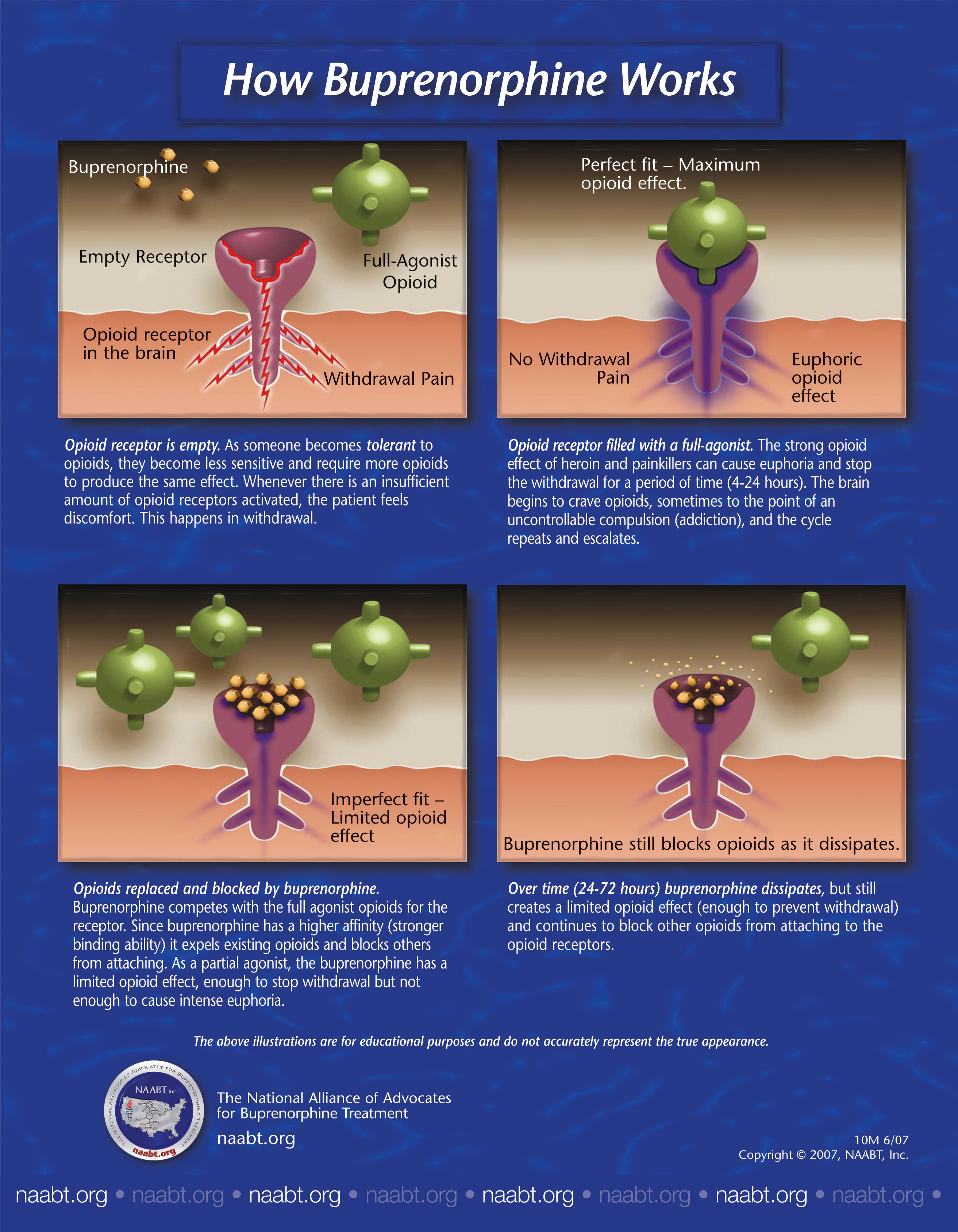
NAABT "How Buprenorphine Works"
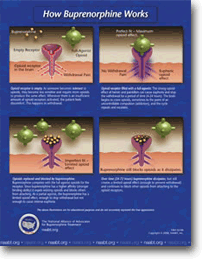 The effect of buprenorphine on the brain is explained in an illustrative, concise fashion. (Updated 6/2007)
(Hi-Res JPEG image suitable for photo printers, 2MB)
PowerPoint slides of this can be downloaded as well.
The "Bowling Ball" analogy, written by Dr. Richard Gracer.
AddictionSurvivors.org Peer Support Brochure

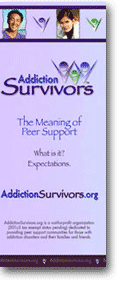 "The Meaning of Peer Support. What is it? Expectations" discusses different types of peer support, and how it differs from therapy and the other components of a complete recovery plan.
NAABT Emergency Contact Wallet Card
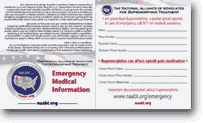 This important addition to a patient's wallet includes spaces for not only important contact numbers for the patient, but also important resources for healthcare workers unfamiliar with buprenorphine.
Directs healthcare workers in an emergency to:
www.naabt.org/emergency
NAABT Matching System Patient Registration Instructions (Counter Display Refills)
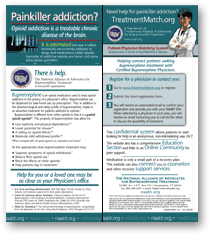 4"x9" in size, side one is a brief description of buprenorphine, side two is an explanation of the NAABT patient/physician matching system.
Pharmacies can order these refills for their counter displays here
NAABT Matching System Physician Instructions
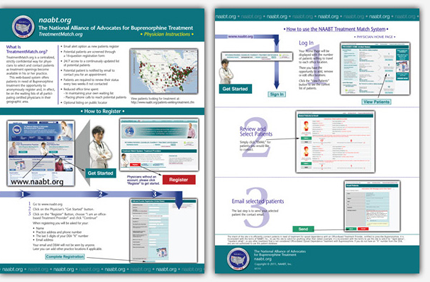 The NAABT Patient/Physician Matching System (PPMS) confidentially connects patients with participating certified buprenorphine-prescribing physicians. This instruction sheet shows how to register and use the system to contact patients seeking buprenorphine treatment.
SAMHSA TIP 40 (Treatment Improvement Protocols)

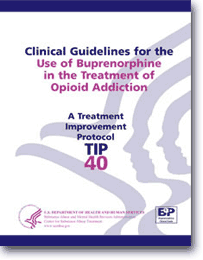 The most downloaded item on naabt.org: TIP 40: Clinical Guidelines for the Use of Buprenorphine in the Treatment of Opioid Addiction. This best-practice guideline for the treatment of substance use disorders provides consensus- and evidence-based guidance on the use of buprenorphine for the treatment of opioid addiction.
All TIPs are available directly from the US Health Department in PDF and hardcopy form.
(TIP 39) Substance Abuse Treatment and Family Therapy
(TIP 41) Substance Abuse Treatment: Group Therapy
(TIP 42) Substance Abuse Treatment for Persons With Co-Occurring Disorders
(TIP 43) Medication-Assisted Treatment for Opioid Addiction in Treatment Programs
(TIP 44) Substance Abuse Treatment for Adults in the Criminal Justice System
(TIP 45) Detoxification and Substance Abuse Treatment
Order your own hard copies of TIPs for free from the US Health Department
NIDA "The Science of Addiction"

 Released February 13, 2007, this NIDA (National Institute on Drug Abuse) 30-page full-color booklet explains in layman's terms how science has revolutionized the understanding of drug addiction as a brain disease that affects behavior. NIDA hopes this new publication will help reduce stigma against addictive disorders.
NIDA Articles that address Research on Heroin
 This NIDA Notes Series "A Collection of articles that address Research on Heroin (NN0023) contains 17 studies and articles about heroin addiction, and the treatment of, including buprenorphine treatment.
WHO "Neuroscience of Psychoactive Substance Use and Dependence"

 This World Health Organization comprehensive scientific book on addiction includes basic neurobiology and specific information about various substances.
NIDA Science & Practice Perspectives
 "Practical Considerations for the Clinical Use of Buprenorphine" August, 2004. Written by practicing certified buprenorphine physicians, the guide provides a real world assessment of the methods and issues with using buprenorphine in an office based environment.
NIDA Research Monograph Series
 This 1992 "Buprenorphine: An Alternative Treatment for Opioid Dependence" monograph is based on the papers and discussions from a technical review on "Buprenorphine: An Alternative Treatment for Opioid Dependence" held on March 16-17, 1989, in Rockville, MD. sponsored by (NIDA).
Neuropsychopharmacology

 Buprenorphine Study: Effects of Buprenorphine Maintenance Dose on mu-Opioid Receptor Availability, Plasma Concentrations, and Antagonist Blockade in Heroin-Dependent Volunteers – Mark K Greenwald, Chris-Ellyn Johanson, David E Moody, James H Woods, Michael R Kilbourn, Robert A Koeppe, Charles R Schuster and Jon-Kar Zubieta (2003)
NIDA Science & Practice Perspectives
 "The Neurobiology of Opioid Dependence: Implications for Treatment" 2002 "Opioid tolerance, physical dependence and addiction are all manifestations of brain changes resulting from chronic opioid use and misuse. The patient's struggle for recovery is in great part a struggle to overcome the effects of these changes..."
Treating Pain in Persons With Substance Use Disorders
 Pain and addiction co-occur frequently, and each can make the other more difficult to treat. This article discusses the neurobiology and clinical presentation of pain and its synergies with substance use disorders, presents methodical approaches to the evaluation and treatment of pain that co-occurs with substance use disorders, and provides practical guidelines for the use of opioids to treat pain in individuals with histories of addiction.
U.S. Department of Justice

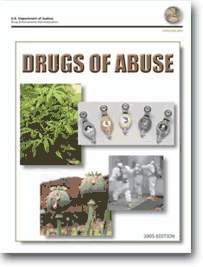 This publication from the Drug Enforcement Agency (DEA), "Drugs of Abuse" provides a non-medical look at addiction. Included are statistics, images of different substances and laws about drugs and drug trafficking. (2005)
SAMHSA Know Your Rights
 Privacy is a big concern. This publication covers special privacy rights afforded to patients with addiction.
SAMHSA Know Your Rights - MAT
 Privacy is a big concern. This publication covers special privacy rights afforded to patients specifically utilizing MAT (Medication Assisted Treatment). It is illegal to deny housing based on MAT.
Science

 Bibliography of major scientific publication with links to many study abstracts. A great place to start when looking for very specific research or information.
NIDA Principles of Drug Treatment
 A Research based guide National Institute on Drug Abuse. 1999
Alcoholic Anonymous

 "The AA Member – Medications & Other Drugs" AA's official publication regarding the use of medications - Revised 2011
Grand Jury for Baltimore City

 "Report of the Grand Jury for Baltimore City, January 2008 Term" Investigation of Buprenorphine treatment – 2008
The Facts about Buprenorphine for Treatment of Opioid Addiction
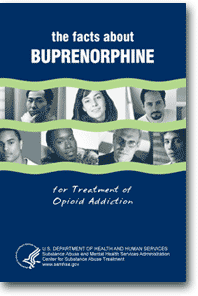 This short booklet provides basic information about the use of buprenorphine in medication-assisted treatment for opioid addiction. It describes how buprenorphine works, the proper use of the medication, and common side effects. It also explains how buprenorphine fits into the overall recovery process. The booklet is for patients entering medication-assisted treatment for opioid addiction, and it may be useful to patients' family members and friends. SAMHSA, 2009
TAP 30
 This guide is intended to provide nurses with general information about buprenorphine products for the pharmacological treatment of opioid addiction.
Articles on Stigma and Language
What's in a word? Addiction Versus
Dependence in DSM-V - CHARLES P. OBRIEN, M.D., PH.D., NORA VOLKOW, M.D. T-K LI, M.D.
- PDF Version -
Edwin A. Salsitz, MD.,FASAM articulates on Addiction Medicine vocabulary
The Rhetoric of Recovery Advocacy: An Essay On the Power of Language by Bill White
The Purpose of Buprenorphine Treatment:
To suppress the debilitating symptoms of cravings and withdrawal, enabling the patient to engage in therapy, counseling and support, so they can implement positive long-term changes in their lives which develops into the new healthy patterns of behavior necessary to achieve sustained addiction remission. - explain -
The National Alliance of Advocates for Buprenorphine Treatment is a non-profit organization charged with the mission to:
- Educate the public about the disease of opioid addiction and the buprenorphine treatment option.
- Help reduce the stigma and discrimination associated with patients with addiction disorders.
- Serve as a conduit connecting patients in need of treatment to buprenorphine treatment providers.
- U.S. Food and Drug Administration, FDA Talk Paper, T0238, October 8, 2002, Subutex and Suboxone approved to treat opiate dependence.
- Center for Substance Abuse Treatment. Clinical Guidelines for the Use of Buprenorphine in the Treatment of Opioid Addiction. Treatment Improvement Protocol (TIP) Series 40. DHHS Publication No. (SMA) 04-3939. Rockville, Md: Substance Abuse and Mental Health Services Administration, 2004.
- Subutex Discontinued in the US market in late 2011.
- Zubsolv (bup/nx sublingual tablet) FDA approved 7/3/2013 see buprenorphine pipeline graphic -in pharmacies now.
- Bunavail (bup/nx bucal film) FDA approved 6/6/2014 see buprenorphine pipeline graphic -in pharmacies now.
- Probuphine FDA approved 5/26/2016 - FDA Probuphine press release